FREE DELIVERY on qualifying orders
 sales@startsafety.eu / +359 (0)87 8810774
 Wholesale Prices


EN ISO 20471: How to Choose the Right Hi-Vis Class

If you have been asked to buy hi-vis clothing for a team, you will quickly run into EN ISO 20471 and its three classes. At first the standard looks technical, but the logic is simple: the higher the risk of not being seen, the more fluorescent and reflective material the clothing must have.
In this guide we explain what EN ISO 20471 requires, how the three classes differ, how to choose the right class for your work and what to check on the label before you buy.
 Pulsar Protect hi-vis yellow long-sleeved polo shirt P458 – Class 3
 Pulsar Protect hi-vis orange long-sleeved polo shirt PR470 – Class 3
What is EN ISO 20471?
EN ISO 20471 is the European and international standard for high-visibility clothing for professional use. It was introduced in 2013 and replaced the old EN 471. The standard sets out how much fluorescent and reflective material a garment must have, where it must be placed and how it must perform after washing, so that the wearer can be seen in daylight, at dusk and in vehicle headlights.
Clothing that only "looks bright" is not hi-vis PPE. Only garments tested and certified to EN ISO 20471 can be used where an employer's risk assessment requires high-visibility clothing.
The two materials every hi-vis garment needs
- Fluorescent background material – in fluorescent yellow, orange-red or red. It makes you stand out in daylight and at dusk, against asphalt, grass, concrete and machinery.
- Retroreflective material – the silver bands. They reflect light straight back to its source, so in the dark a driver sees you in their headlights from a long distance.
Both are needed: fluorescent material does almost nothing in the dark, and reflective tape does little in daylight.
The three classes of EN ISO 20471
The class shows the minimum area of each material on the garment. The higher the class, the higher the visibility.
| Class | Fluorescent material | Reflective material | Typical garments |
|---|---|---|---|
| Class 1 | 0.14 m² | 0.10 m² | shorts, some trousers and bib-and-brace trousers |
| Class 2 | 0.50 m² | 0.13 m² | vests, short-sleeved polo shirts, trousers |
| Class 3 | 0.80 m² | 0.20 m² | jackets, long-sleeved tops, coveralls |
Class 3 also requires the garment to cover the torso and to have reflective bands on the sleeves or full-length legs, so that the outline of the body is visible. That is why a jacket with sleeves or a coverall reaches Class 3, while a vest normally stays at Class 2.
How to choose the right class
The class is chosen based on the risk assessment for the specific job – the speed and volume of traffic, how close people work to vehicles and machinery, lighting and weather. As a practical guide:
| Working environment | Recommended class | Example from our stock |
|---|---|---|
| Warehouses, factory floors, car parks with slow-moving vehicles | Class 2 (Class 1 only for very low risk) | polo shirt P175 |
| Construction sites, logistics yards, loading docks, ports | Class 2 minimum, Class 3 near moving machinery | cargo trousers P346 + long-sleeved polo P458 |
| Road works, roadside work, railways, night work, poor weather | Class 3 | storm coat P421 or coverall PR505 |
When in doubt, choose the higher class. The difference in price is small compared with the cost of an accident. Many construction companies and investors also set their own minimum, often Class 3 on the whole site, so always check the site rules.
 Pulsar Protect hi-vis yellow polo shirt P175 – Class 2
 Pulsar Protect hi-vis yellow cargo trousers P346 – Class 2
Can you combine two garments to reach Class 3?
Yes, but only under one condition: the combination must be tested and certified by the manufacturer as an ensemble. For example, a Class 2 top and Class 2 trousers can together give Class 3 if this is stated in the manufacturer's information. Simply putting on two Class 2 garments does not automatically make Class 3.
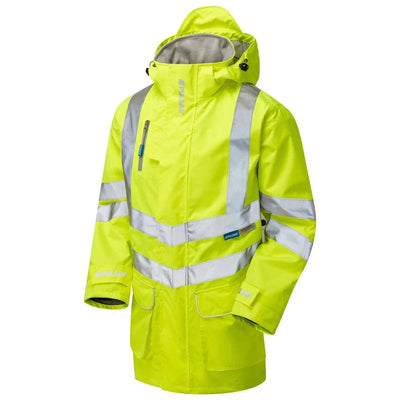
The simplest way to be sure is to have the outer layer itself certified to Class 3 – for example the Pulsar Protect storm coat P421 or PR499, the fleece jacket PR508, the softshell jacket PR535, or the coveralls P522 and PR505.
 Pulsar Protect hi-vis yellow storm coat P421 – Class 3
 Pulsar Protect hi-vis orange coverall PR505 – Class 3
How to read the label
Every certified garment carries a label with the EN ISO 20471 pictogram – a jacket symbol with the standard number and a digit next to it showing the class (1, 2 or 3). Also look for:
- CE marking – hi-vis clothing is PPE under Regulation (EU) 2016/425 and must have an EU declaration of conformity;
- maximum number of washes – the number of washes after which the garment still meets its class (for Pulsar Protect, 25 washes);
- size range for the class – in small sizes there is less fabric, so some garments reach a lower class in the smallest sizes.
Common mistakes that reduce visibility
- Covering the hi-vis. A normal jacket over a hi-vis vest, or a backpack over the reflective bands, takes away the protection.
- Large logos and prints. Embroidery and prints over the fluorescent fabric reduce its area and can drop the garment below its class. Add branding only in a way the manufacturer allows.
- Rolled-up sleeves and trousers tucked into boots. These hide the reflective bands, especially on the legs.
- Old and dirty clothing. Faded colour, cracked tapes and dirt reduce visibility – such garments need replacing.
- "Enhanced visibility" clothing. Some products only have reflective details but are not certified to EN ISO 20471. They are fine for leisure, not for work where hi-vis PPE is required.
Yellow or orange?
The standard treats fluorescent yellow, orange-red and red equally. The choice depends on the background you work against and on site rules. Yellow is the most common choice on construction sites and in logistics. Orange stands out better against green vegetation and snow and is often chosen for road and rail works. If your client or investor specifies a colour, follow it. We stock most Pulsar Protect models in both colours.
Our EN ISO 20471 range by class
- Class 3: long-sleeved polo P458 / PR470, storm coat P421 / PR499, fleece PR508, softshell PR535, coverall P522 / PR505
- Class 2: polo P175 / PR176, cargo trousers P346 / PR336, overtrousers P206TRS / PR503TRS, body warmer P422 / PR498
Frequently asked questions
Is a hi-vis vest enough?
A vest is usually Class 2. It is enough for many warehouse and site jobs, but not where the risk assessment requires Class 3 – for example on road works. There you need a jacket with sleeves, a long-sleeved top or a coverall certified to Class 3.
Who pays for hi-vis clothing?
When the risk assessment shows that hi-vis clothing is needed, it is personal protective equipment and the employer provides it free of charge to the worker.
How long does hi-vis clothing last?
It depends on use and washing. The label shows the maximum number of washes for which the class is guaranteed. Replace the garment earlier if the colour fades, the tapes crack or peel, or the fabric is torn.
Order certified hi-vis clothing from Start Safety EU
All the products in this article are certified to EN ISO 20471 and are in stock in our warehouse in Varna. Not sure which class you need, or want to kit out a whole team? Call us on +359 (0)87 8810774 or email sales@startsafety.eu – we will help you choose and prepare a quote for your company.
The Start Safety EU team
- Author
- Tags